
Please pass this on to all who might be interested! Join an expedition to discover the world of glaciers Girls on Ice is a unique eleven-day leadership program f or teenage girls that combines leadership, mountaineering and science. The program takes place *July 28-August 7, 2008 * and is free to girls who qualify via amerit-based application process. It is open to girls 15-18 years old who have shown a keen interest in exploring the world of science and the outdoors. Nine young women will be selected and the ideal candidate willbe an inquisitive, adventurous girl who would like to learn more about scientific inquiry, research, careers in science and the North-West environment. It is the only program in the nation that combines leadership, scientific inquiry and mountaineering for teenage girls. Itprovides a rare opportunity for young women to feel at home in the wilderness while observing the natural world through the unique lens of science under the guidance of professional female glaciologists and mountaineers. Applications due March 15, 2008 Please visit Girls on Ice for more information and an application packet or feel free to contact Erin at epettit@pdx.edu.
 or teenage girls that combines leadership, mountaineering and science. The program takes place *July 28-August 7, 2008 * and is free to girls who qualify via amerit-based application process. It is open to girls 15-18 years old who have shown a keen interest in exploring the world of science and the outdoors. Nine young women will be selected and the ideal candidate willbe an inquisitive, adventurous girl who would like to learn more about scientific inquiry, research, careers in science and the North-West environment. It is the only program in the nation that combines leadership, scientific inquiry and mountaineering for teenage girls. Itprovides a rare opportunity for young women to feel at home in the wilderness while observing the natural world through the unique lens of science under the guidance of professional female glaciologists and mountaineers. Applications due March 15, 2008 Please visit Girls on Ice for more information and an application packet or feel free to contact Erin at epettit@pdx.edu.

+072.jpg)


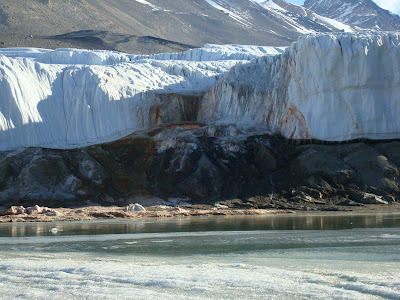
 All of these things together lead scientists to believe that the changes in the lakes of the Dry Valleys are a good representation of the changes that could occur in our world if global warming continues.
+064.JPG)


